
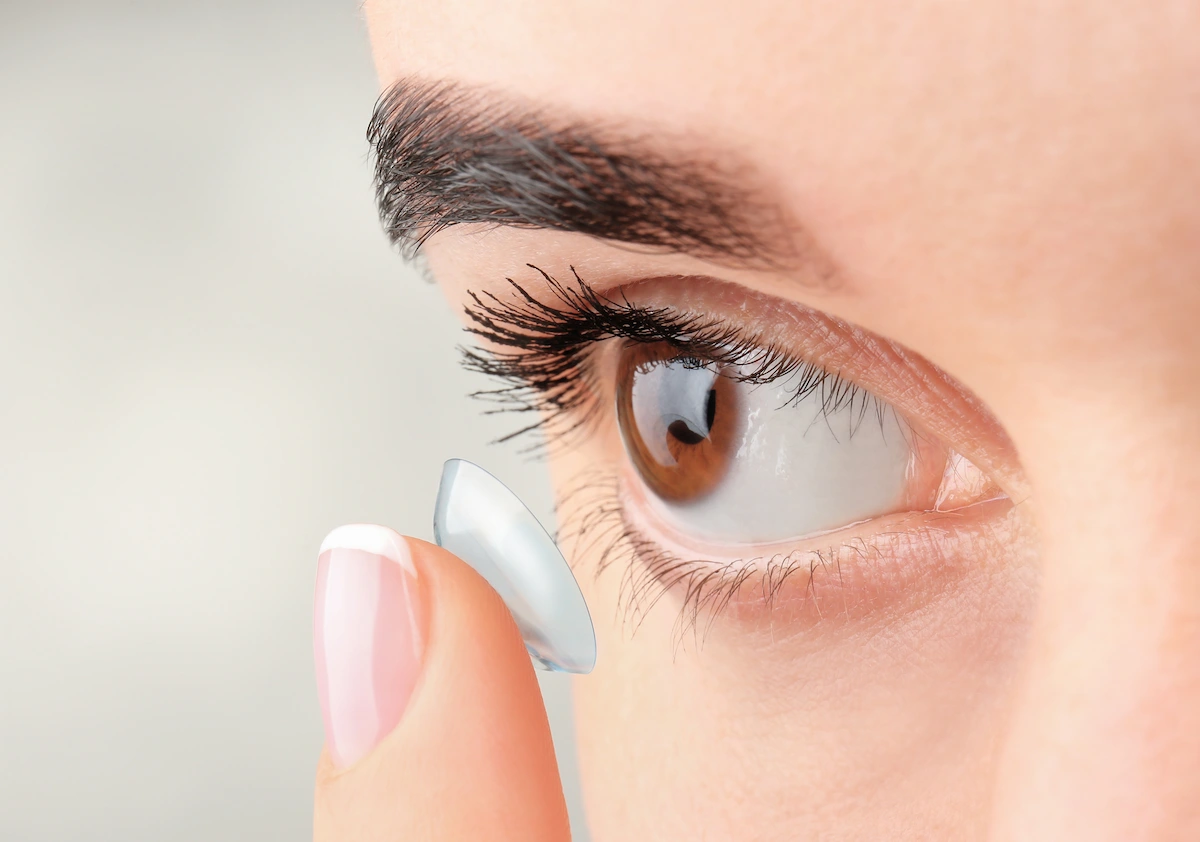
For people whose vision or comfort needs are not fully addressed with standard contacts, scleral lenses can be a valuable option. They are not simply “bigger contacts.” Their customized fit can help patients manage certain corneal conditions, eye-surface concerns, and vision challenges.
People with irregular corneas
An irregularly shaped cornea can scatter light as it enters the eye, causing blurry, distorted, or fluctuating vision. Standard soft contacts may follow the uneven contour of the eye rather than correct it.
Scleral lenses vault over the cornea and create a more even front surface for light to pass through. This can help people with conditions such as keratoconus, a condition that causes the cornea to become thinner and more cone-shaped. Patients may notice clearer, more stable vision than they achieve with glasses or conventional contacts.
People with dry eye or ocular surface disease
Dry eye can make wearing traditional contact lenses frustrating. Burning, grittiness, redness, excessive tearing, and fluctuating vision can all make lenses uncomfortable or difficult to wear for a full day.
Because scleral lenses hold a reservoir of fluid between the lens and cornea, they may provide a protective cushion for some people with dry eye or ocular surface disease. We can help determine what is contributing to symptoms and whether scleral lenses may complement a broader dry eye treatment plan.
People who cannot tolerate other contact lenses
Some patients have tried soft lenses, rigid gas-permeable lenses, or both without finding a comfortable fit. They may experience lens movement, dryness, irritation, or unstable vision throughout the day.
Scleral lenses rest on the less-sensitive white part of the eye instead of directly on the cornea. Their larger size and customized fit can make them a practical alternative for people who need sharper vision but have been unable to comfortably wear other lens types.
People with astigmatism or presbyopia
Astigmatism occurs when the cornea or lens has an uneven curve, which can cause blurred or distorted vision at different distances. Presbyopia, which becomes more common after age 40, makes close-up tasks more difficult.
Many people with these conditions do well with glasses or standard contact lenses. However, scleral lenses may be considered when vision remains inconsistent, when astigmatism is more complex, or when another eye-surface concern is also affecting comfort.
People with vision changes after refractive surgery
LASIK and PRK can reduce dependence on glasses or contacts, but not everyone has the same visual outcome. In some cases, people experience irregular corneal shape, dryness, glare, halos, or residual prescription changes after surgery.
A detailed eye exam can help determine the cause of these symptoms. For select patients, scleral lenses may help improve vision quality and comfort after refractive surgery. We can also evaluate whether LASIK vision correction or another option may fit a patient’s current visual goals.
Find a contact lens option built around your eyes
Scleral lenses can offer a meaningful solution for people with complex vision needs, dry eye, or difficulty wearing standard contacts. A specialty contact lens evaluation can determine whether their design and fit are right for your eyes. Schedule an appointment at our Kildeer or Elgin to discuss clearer, more comfortable vision.